
Sophisticated tools such as IoT and AI are taking automated systems to the next level, offering opportunities for manufacturers to address labor shortages and the skills gap.
By: Mark Crawford
Automation drives efficient medical device manufacturing operations by increasing precision, speeding up assembly, and reducing costs for complex assembly tasks. Manufacturing equipment can perform micro-assembly tasks with exact tolerance levels. Automated lines can run continuously to meet high market demands. Automation technologies enable high-precision assembly of miniaturized components and medical devices, reducing the margin of error and improving overall product quality.
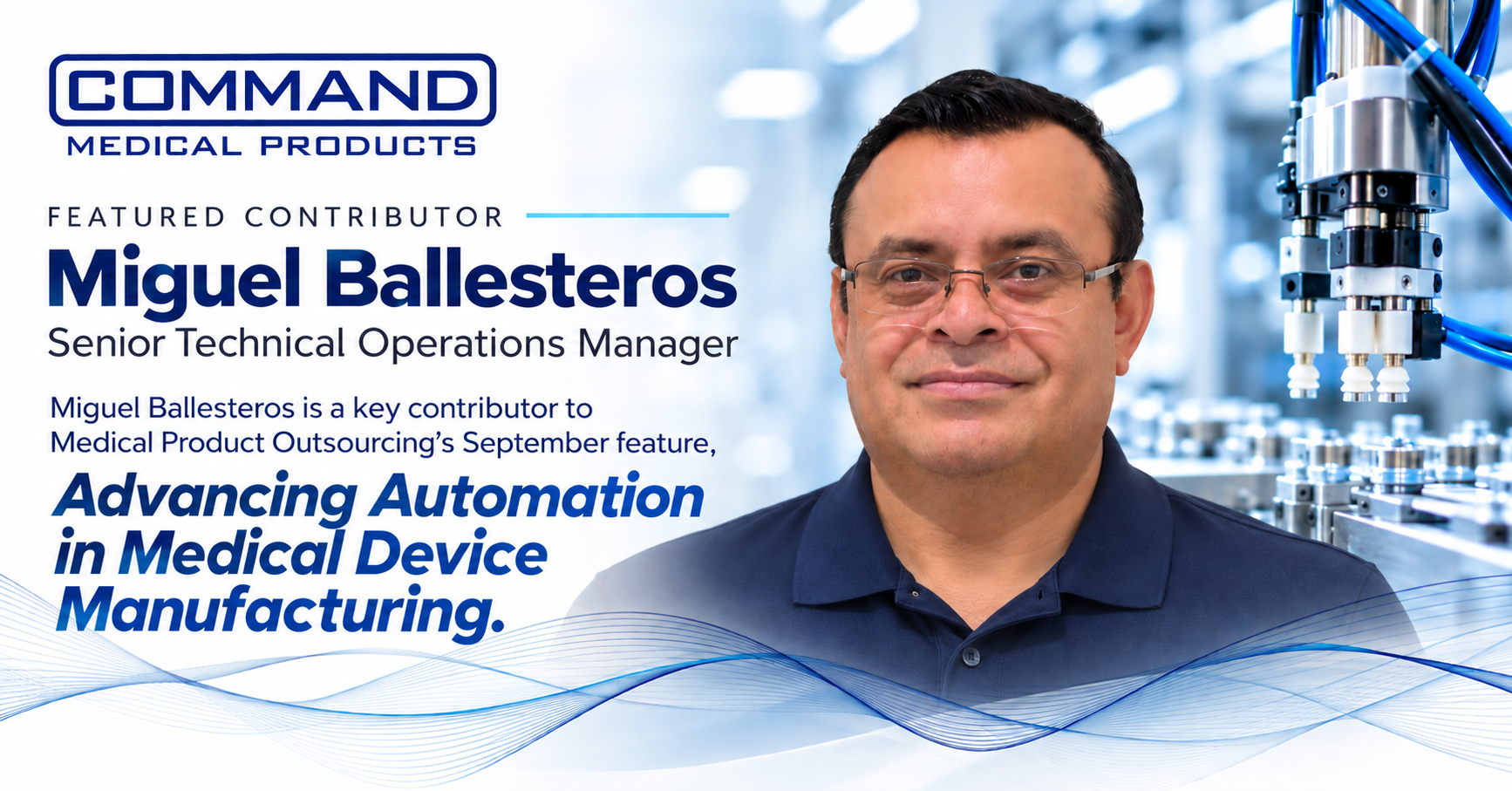
However, even with these proven advantages, fully automated production remains the exception, rather than the rule. For example, many disposable medical devices still require manual operations because of their size, flexibility, and product variation. Therefore, medical device manufacturers (MDMs) and their contract manufacturers (CMs) focus on “automating those operations that have the greatest impact on quality, repeatability, and throughput, while maintaining operator involvement where engineering judgment adds value,” said Miguel Ballesteros, senior technical operations manager for Ormond, Fla.-based Command Medical Products, a contract manufacturing organization specializing in single-use fluid management devices for the infusion, general surgical, and lab/diagnostic markets.